China Three Gorges University Clinical Medicine 2026: Fees and Admission Guide
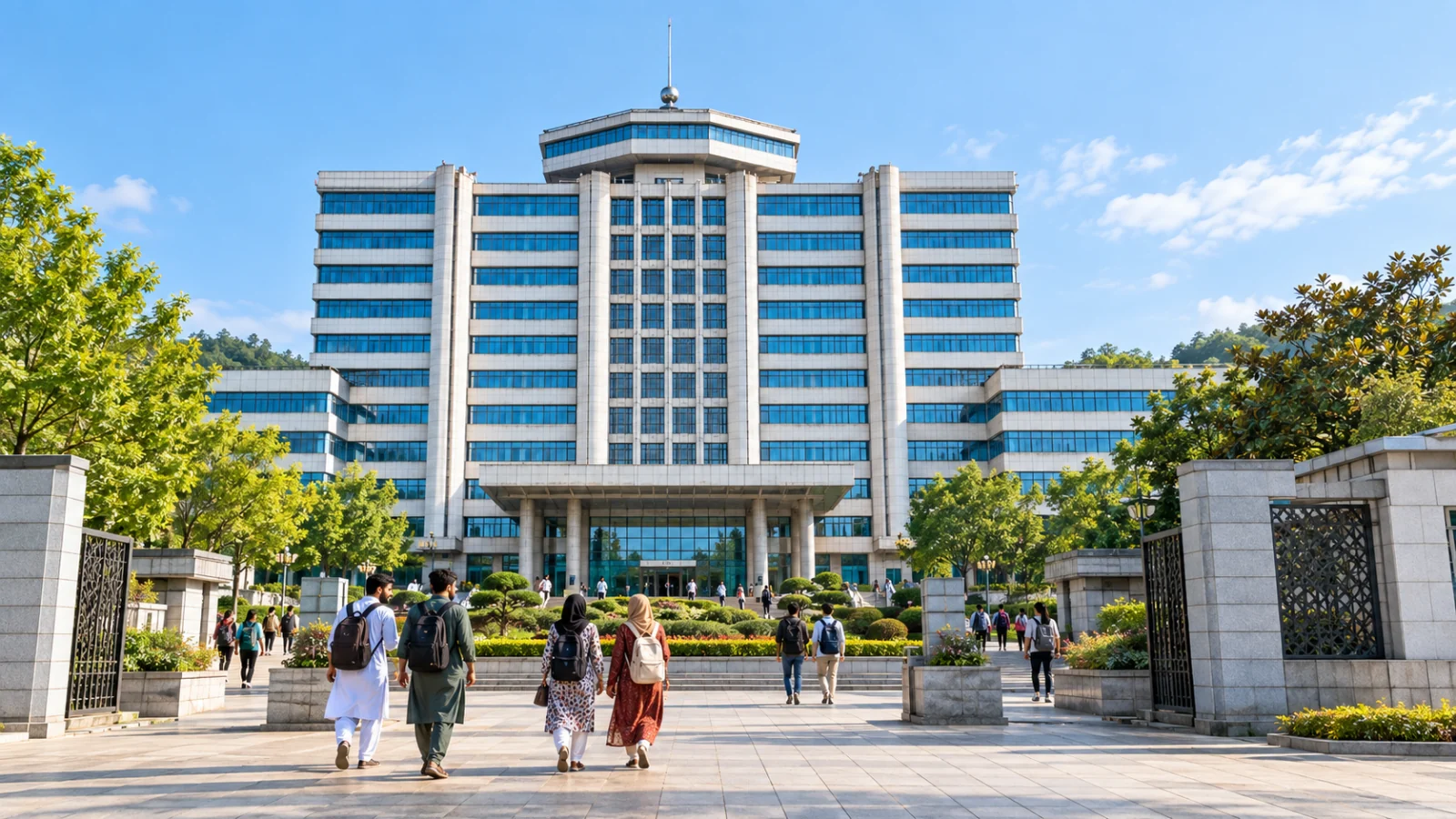
Editorial reconstruction based on CTGU’s official architectural image of its real main campus building
A six-year Chinese-medium Clinical Medicine intake in Yichang
China Three Gorges University’s official 2026–27 prospectus lists Clinical Medicine as a six-year, Chinese-taught undergraduate programme. It sets annual tuition at RMB 24,000, requires CSCA STEM Chinese and Mathematics in English, and gives 30 June 2026 as the application deadline with the CSCA score report due by 15 July 2026. CTGU has historical English-MBBS evidence, but the current prospectus must control the 2026 intake decision.
Duration: 6 years
2026 tuition: RMB 24,000/year
Teaching: Chinese-medium
CSCA: STEM Chinese + Mathematics (English)
2026 deadline: 30 June
Is China Three Gorges University a realistic MBBS option?
CTGU may suit a Pakistani applicant aged 18 to 25 who can genuinely study medicine in Chinese, prepare the two published CSCA components and fund a six-year degree. The official 2026–27 prospectus lists RMB 24,000 annual tuition, an RMB 400 registration fee, a double-room bed at RMB 4,800 per year and average living expenses of about RMB 1,500 per month. Admission, language readiness, room allocation, visa approval and Pakistan-side professional eligibility remain separate decisions.
Current Chinese-medium intake versus historical English-MBBS evidence
CTGU’s 2026–27 prospectus is the controlling public intake document reviewed for this page. Its undergraduate table lists Clinical Medicine for six years in Chinese, with CSCA STEM Chinese and Mathematics in English. CTGU also maintains an older official MBBS page describing a 5+1-year English programme and says it received MOE qualification in 2011. The 2023–24 MOE list recorded CTGU with an English Clinical Medicine quota of 20. Those older and standing sources establish programme history; they do not convert the current Chinese-medium 2026 listing into an English seat.
Verified in current official sources
- Clinical Medicine is listed for six years with Chinese as the language of instruction in the 2026–27 prospectus.
- Bachelor’s applicants should hold a higher-secondary certificate or equivalent and are generally 18–25 years old.
- Chinese-taught applicants need HSK 4 at application; CTGU states Chinese-medium graduates should reach ICLPS Level 5 by graduation.
- The Clinical Medicine CSCA combination is STEM Chinese and Mathematics in English.
- The 2026 application deadline was 30 June; the CSCA score-report deadline was 15 July.
- Self-funded Clinical Medicine tuition is RMB 24,000 per year; registration is RMB 400.
- A bed in a two-person room is RMB 4,800 per year; water, electricity, internet and damage charges are extra.
- The official 2023–24 MOE list recorded an English Clinical Medicine quota of 20, while the current prospectus lists Chinese medium.
Must still be confirmed for the applicant or next intake
- Whether the next prospectus keeps Clinical Medicine Chinese-medium or restores any separate English route.
- How CTGU evaluates Pakistani HSSC/FSc Pre-Medical marks and whether a programme-specific minimum applies.
- The next application and CSCA result deadlines, accepted test session and any minimum CSCA score.
- The exact HSK test date, score validity and whether any conditional language route is available.
- The tuition payment schedule, the applicable RMB 800 or RMB 600 insurance category, deposits and refund conditions.
- The assigned residence, utilities, arrival date, clinical sites and internship rules for the admitted cohort.
- Current PM&DC personal eligibility, student-registration, internship and later licensing requirements.
A copied agent sheet or social-media post cannot replace the official 2026–27 prospectus, the applicant’s decision in CTGU’s official application system and the university invoice. The prospectus lists the Admissions Office email as [email protected] and telephone +86 717 6394999. Ask one direct question in writing: “For my intended intake, is Clinical Medicine Chinese-medium or is a separately approved English route open?” Preserve the dated reply.
Understanding the six-year Chinese Clinical Medicine programme
CTGU’s official 2026–27 programme table identifies Clinical Medicine as a six-year programme taught in Chinese. “MBBS” appears on this page only because Pakistani families commonly use it as a search term for an undergraduate medical degree in China. The offer, academic record and final award should be checked against CTGU’s exact wording. Applicants should not assume that an older English MBBS webpage defines the current teaching language.

Programme identity
The current guide names the programme Clinical Medicine, lists a six-year duration and marks Chinese as the teaching language. Those three details should appear consistently on the offer, visa documentation and registration record.
Six-year commitment
Six years is a long academic and financial commitment. Families should plan for annual tuition, residence, insurance, living costs, travel and a contingency across the complete period, not only for the first payment.
Chinese-language commitment
This is not merely a Medical Chinese add-on. The current programme is Chinese-medium. HSK 4 is the stated application level and CTGU says Chinese-medium bachelor’s graduates should reach ICLPS Level 5 by graduation.
Clinical placement evidence
Before admission, ask for the current clinical-training structure, the hospitals normally used, internship rules, teaching language during patient contact and the records issued for rotations and attendance.
Questions the admission catalogue does not answer by itself
Request the current Chinese-medium curriculum, credit plan and assessment rules. Confirm how basic sciences, clinical subjects, laboratory learning and bedside training are sequenced.
Ask how general Chinese, scientific Chinese and Medical Chinese are assessed, what progression standard applies each year, and whether clinical examinations are entirely in Chinese.
Confirm the affiliated hospitals, allocation process, supervision, attendance recording and whether the university can change the placement site during the programme.
Ask whether the sixth year includes internship or clerkship, where it can be completed, who approves an outside placement and which documents are issued afterwards.
Programme evidence: the official 2026–27 prospectus, the official 2026–27 CSCA table, the standing official MBBS history page, the official 2023–24 MOE notice and the Clinical Medicine accreditation directory, which lists CTGU’s accreditation through December 2028.
China Three Gorges University Clinical Medicine eligibility planning
The 2026 prospectus requires a non-Chinese citizen who is friendly to China and healthy physically and mentally. Bachelor’s applicants should hold a higher-secondary certificate or equivalent and are generally 18–25 years old. The guide does not publish a Pakistan-specific HSSC percentage or science-subject cutoff, so Pakistani applicants need an individual written decision on the full FSc Pre-Medical or equivalent record.

General applicant conditions
- A non-Chinese citizen with a valid passport and a consistent identity across every record.
- Generally 18–25 years old for a bachelor’s programme, with a higher-secondary certificate or equivalent.
- Friendly to China and in good physical and mental health.
- HSK 4 for the Chinese-taught route; the active intake must confirm the accepted test and validity.
- CSCA STEM Chinese and Mathematics in English for Clinical Medicine.
- Supporting health, conduct, funding and language documents in the current required format.
Pakistani academic file
- Submit the complete HSSC/FSc Pre-Medical or equivalent certificate and subject-wise transcript.
- Present the actual Physics, Chemistry and Biology results; CTGU publishes no Pakistan-specific minimum percentage in this prospectus.
- Use Chinese or English documents, with notarised Chinese or English translations where the originals are in another language.
- Keep the CTGU decision separate from Pakistan’s FSc, MDCAT, PM&DC student-registration and licensing conditions.
- Prepare CSCA STEM Chinese and Mathematics in English, not Chemistry or Physics borrowed from another university.
- Incomplete, mistranslated or inconsistent documents can delay or prevent admission.
Chinese-language route for Clinical Medicine
The current prospectus says HSK 4 holders may apply to Chinese-medium programmes. It also says graduates of Chinese-medium bachelor’s programmes should reach Level 5 of the International Chinese Language Proficiency Standards. A Pakistani student should treat HSK 4 as an entry threshold, not proof that six years of medical lectures, examinations and patient contact will be easy. Ask CTGU about any programme-specific HSK score, preparatory language period, annual progression test and clinical-language requirement.
CTGU’s general English-programme rule of IELTS 6.0 or equivalent does not turn Clinical Medicine into an English programme. It applies to programmes identified as English-taught. The current Clinical Medicine row is Chinese. A medium-of-instruction letter from Pakistan therefore does not replace the published Chinese requirement.
| Stage | Official 2026 evidence | Practical check |
|---|---|---|
| Application | HSK 4 for Chinese-medium programmes | Confirm the accepted score, issue date and result-verification route. |
| CSCA | STEM Chinese plus Mathematics in English | Prepare Chinese scientific vocabulary as well as mathematical reasoning. |
| Study | Clinical Medicine is marked Chinese-medium | Ask which textbooks, lectures, assessments and clinical records are in Chinese. |
| Graduation language | ICLPS Level 5 for Chinese-medium bachelor’s students | Request the university’s assessment and certification procedure. |
Prepare for CSCA STEM Chinese and Mathematics in English
CTGU’s dedicated 2026–27 CSCA table lists two components for Clinical Medicine: STEM Chinese and Mathematics in English. It gives 15 July 2026 as the latest date for the CSCA score report. The public table does not publish a minimum score, accepted sitting or interview formula, so those details require the next guide or a written admissions reply.

What the official guide confirms
- STEM Chinese is required for Clinical Medicine.
- Mathematics is required in English.
- The CSCA score report is one of the listed undergraduate application materials.
- The 2026 score-report deadline was 15 July.
- Admission remains selective; uploading a result does not guarantee an offer.
What CTGU must confirm next
- The CSCA sessions accepted for the next intake.
- The next score-report deadline and official delivery method.
- Any minimum overall or component score.
- Whether an interview, document review or additional assessment follows CSCA.
- Whether the next prospectus changes the programme language or subject pair.
A workable preparation sequence
- Download the official STEM Chinese and Mathematics specifications and map every topic against the preparation schedule.
- Create the CSCA account with the same passport name and date of birth used in the CTGU application.
- Choose a session that leaves enough time for the valid report to reach CTGU before the active deadline.
- Practise scientific terminology in Chinese as well as mathematical reasoning in English.
- Keep the result, application form, transcript, HSK record and passport identity consistent.
- Do not substitute Chemistry, Physics or an English STEM paper simply because another medical university asks for it.
- Prepare for an interview only if CTGU’s portal or written notice requires one.
Use the official CSCA website for registration, syllabus and test notices, and use CTGU’s official 2026 admission page for the university requirement.
China Three Gorges University Clinical Medicine fee planning
CTGU’s official 2026–27 prospectus lists self-funded Clinical Medicine tuition at RMB 24,000 per year. It gives a registration fee of RMB 400, a two-person room at RMB 4,800 per year per bed, insurance at RMB 800 or RMB 600 per year per person, and average living expenses of about RMB 1,500 per month. It also estimates about RMB 1,500 in other items such as health examination, authentication and residence-permit application, charged under the relevant authority’s standard.
Official self-funded Clinical Medicine figure; future standards can change.
Budget beyond the first payment and include clinical years.
An arithmetic scenario, not a fixed university quotation.
Water, electricity, internet and damage charges are excluded.
A prospectus estimate, not a personal spending limit.
Confirm the official payment route, timing and refund position.

Six-year planning example
If the published RMB 24,000 tuition stayed unchanged for six academic years, tuition alone would total RMB 144,000. Six years of the published RMB 4,800 bed fee would add RMB 28,800, producing an RMB 172,800 tuition-and-room model before registration, insurance, living expenses, utilities, travel and other charges. This is arithmetic for planning, not a university promise that rates, room allocation or study duration will remain unchanged.
| Official prospectus item | 2026 amount | Practical note |
|---|---|---|
| Registration fee | RMB 400/person | Confirm timing, official payee and refund terms. |
| Clinical Medicine tuition | RMB 24,000/year | Obtain the applicant-specific invoice and payment schedule. |
| Two-person room | RMB 4,800/year/bed | Water, electricity, internet and damage compensation are excluded. |
| Insurance | RMB 800 or RMB 600/year/person | Ask which category applies to the admitted student and what it covers. |
| Living estimate | About RMB 1,500/month/person | Food, transport and personal choices can move the total. |
| Other stated estimate | About RMB 1,500 | Examples include health examination, authentication and residence-permit application, charged by the relevant institution. |
Food, local transport, mobile service, laundry, study supplies, clothing and personal spending are not included in the known core calculation.
Plan for travel, visa work, medical checks, residence-permit formalities, document notarisation or legalisation, deposits and initial household items.
PKR/RMB movement and bank or remittance charges can change the real family cost. Keep a contingency rather than funding only the quoted amount.
A repeat, delayed completion, changed residence allocation or extra travel during clinical training can add costs beyond a simple six-year multiplication.
Scholarship, insurance and unquoted costs
CTGU’s brochure describes university and provincial scholarship routes, but scholarship coverage and award decisions depend on the specific category. Do not subtract any scholarship from the family budget until a written award identifies the recipient, programme, amount, coverage period, renewal standard and payment timing. Request the named-student invoice, official account, applicable insurance category, residence details, utility rules and written refund policy before remitting money.
What Pakistani students must verify before admission
Three separate questions are often mixed together: whether a programme appears in a Chinese MOE English Clinical Medicine list, whether CTGU admits the individual applicant, and whether the student meets Pakistan’s rules for foreign medical education and later registration. A “yes” to one is not an automatic “yes” to the others.

- 1Check Pakistan-side admission eligibility
Read the PM&DC foreign-undergraduate policy that applies to your admission session. Check FSc or equivalent, MDCAT, subject and any other stated conditions using your own documents—not a friend’s case.
- 2Verify the institution and programme
Confirm the current institution and qualification criteria required by PM&DC, including any regulator, directory or allopathic-medicine conditions. Save dated evidence before paying.
- 3Obtain the required student registration
PM&DC’s current guidance says the Student Registration Certificate should be obtained through its online process before proceeding abroad. An admission letter does not replace this step.
- 4Protect academic and clinical records
Keep official syllabi, transcripts, attendance, study hours, rotation letters, clinical logbooks and internship documents. PM&DC guidance refers to programme duration, attendance and total instructional requirements that later need proof.
- 5Recheck internship and provisional registration
A separate PM&DC notice addresses provisional registration for foreign students or graduates undertaking clinical training, internship, observership or house job in Pakistan. Do not plan an internship location on an informal promise.
- 6Plan for the National Registration Examination
Foreign medical graduates should expect the licensing pathway applicable at the time they return. Rules can change during a six-year degree, so recheck them annually and again before clinical or licensing decisions.
Read the current official documents: PM&DC foreign undergraduate admission guidance and the PM&DC public notice for students seeking admission in foreign institutions.
How to prepare a CTGU international application
The official 2026 application deadline was 30 June. Applicants submitted through CTGU’s online system, followed progress there and downloaded the Admission Notice, DQ and JW201/JW202 after a successful decision. The CSCA report could follow by 15 July. For the next intake, wait for a new official prospectus and do not assume the old dates, programme language, fees or document rules remain unchanged.

Application sequence for the intended intake
- 1Read the active official guide
Record the programme name, Chinese teaching language, deadline, HSK requirement, CSCA STEM Chinese and Mathematics in English, fees and accommodation from the university source.
- 2Check the complete eligibility route
Compare your HSSC science record, age, passport, HSK level and CSCA plan with CTGU requirements, then check PM&DC conditions before paying any fee.
- 3Create the official online application
Use lsx.ctgu.edu.cn and enter names and dates exactly as they appear on the passport and academic records. Keep control of the registered email and password.
- 4Upload a quality-controlled document set
Use complete, legible scans and required notarisation or translation. Never modify a score, stamp, date, employment claim or education history to make the file appear stronger.
- 5Complete CSCA and any additional assessment
Submit valid STEM Chinese and Mathematics-in-English CSCA results by the university’s current deadline, then monitor the portal and registered email for any interview or assessment instruction.
- 6Review admission and payment instructions
Check programme, language, study length, fees, CTGU campus, room and deadline. Remit only through verified CTGU instructions and retain the official receipt.
- 7Complete regulatory, visa and arrival steps
Obtain the required PM&DC student registration, follow the university’s visa-document process and carry original documents for verification at registration.
Document checklist published for the 2026 intake
Complete the official international-student form through the route linked by CTGU and keep the submitted copy.
Provide a clear scanned copy of the valid passport identity page and keep every application field consistent with it.
Upload the degree or graduation certificate, or an expected-graduation certificate, plus the complete academic transcript.
Provide HSK evidence for the Chinese route and the undergraduate CSCA score report using the exact published subject combination.
Write a truthful study or research plan that agrees with the academic history, language preparation and intended programme.
The prospectus lists a recommendation letter. Follow the active portal checklist for the required number, recommender and format.
Provide personal academic achievements or award certificates only where authentic and relevant.
Upload the Foreigner Physical Examination Form and a certificate of no criminal record in the current required format.
Prepare the Financial Support Guarantee Certificate and confirm the current issuer, amount, currency and signature rules.
Use originals or notarised Chinese or English records; attach compliant translations for documents issued in another language.
Unexplained gaps, inconsistent dates and hidden enrolment can create more risk than an honest record with a clear explanation. Originals or properly authenticated documents may be required at registration, so keep the submitted file and the physical file consistent.
Official route: use the CTGU international-student application system. The 2026 prospectus lists the International Students Admissions Office contact as [email protected] and telephone +86 717 6394999. Confirm unexpected account or payment changes through a separately obtained official contact and never send admission money to a personal account.
Accommodation and practical life at CTGU in Yichang
The 2026 prospectus lists RMB 4,800 per year per bed in a two-person room. Water, electricity, internet and compensation for damage to public property are excluded. This is a published planning figure, not a promise that every new Clinical Medicine student receives the same building, room or contract. Confirm the allocation and arrival instructions in the admitted student’s documents.
Residence planning
Use RMB 4,800 per year per bed as the published double-room figure, then confirm the building, facilities, deposit, utilities and contract period.
Registration planning
Keep the original admission, passport, visa, health and academic documents safe and ready for verification. Follow the arrival guide issued with the admission documents.
Clinical-year logistics
Hospital rotations can affect travel time, daily routine and language needs. Ask whether residence changes or extra transport become necessary during clinical training.
Questions to send to CTGU before payment
- Which campus and residence building normally house new Chinese Clinical Medicine students?
- Does the published RMB 4,800 cover one bed for the full academic year?
- Which water, electricity, internet, bedding, air-conditioning or heating charges are separate?
- Is a deposit required, and what conditions apply to its return?
- Can first-year students choose a room or does CTGU allocate one?
- What happens if the listed two-person room is unavailable?
- What off-campus permission and police-registration rules apply?
- What arrival date, medical check, insurance and residence-registration steps apply?
- How is clinical placement transport handled in later years?
- Which emergency, health and international-student support contacts are available?
Yichang has a humid subtropical climate with hot, humid summers, frequent heavy rain and generally mild winters. CTGU estimates average living expenses at about RMB 1,500 per month, but food, local transport, dietary needs, communication, clothing, health and personal choices can move that figure. The university’s official campus page includes a map and architectural images; applicants should still ask which teaching and residence sites apply to their cohort.
Who may find CTGU a suitable choice?
A shortlist should reflect the student’s actual profile, not only the university name. Compare academic fit, testing readiness, total cost, language expectations and Pakistan’s professional pathway before deciding.
It may suit you if…
- You are generally 18–25 and CTGU confirms that your complete HSSC Pre-Medical record meets the current standard.
- You already have, or can honestly achieve, HSK 4 and can sustain a Chinese-medium medical degree.
- You can prepare CSCA STEM Chinese and Mathematics in English.
- Your family can fund six years without assuming an unconfirmed scholarship.
- You accept shared campus accommodation and the real language demands of lectures, examinations and patient communication.
- You will complete PM&DC checks before travel and protect detailed academic records throughout the degree.
Pause and verify if…
- You have been promised a current English MBBS seat without a dated CTGU intake document.
- You are relying on an English medium-of-instruction letter instead of HSK and Chinese readiness.
- You are being told that Chemistry or Physics replaces the published STEM Chinese plus Mathematics requirement.
- You need a guaranteed scholarship, single room or fixed PKR price.
- You are relying on the historical MOE quota of 20 as a promise of a current seat.
- You have not checked PM&DC student registration, internship and NRE conditions.
A seven-day readiness audit
- Collect the complete HSSC transcript and ask CTGU to confirm eligibility because no Pakistan-specific percentage is published.
- Assess current HSK ability honestly and list the gap between conversational Chinese and Chinese-medium medical study.
- Prepare CSCA STEM Chinese and Mathematics in English and monitor the next guide for the accepted session and result deadline.
- Build a six-year RMB budget using tuition as one line, then add residence, registration, insurance, living, travel and contingency separately.
- Read PM&DC’s current foreign-admission guidance and record the student-registration steps that apply before departure.
- Prepare a clean document folder with consistent names, dates, scans, translations, recommendation, health, conduct and funding certificates.
- Wait for the next official prospectus, submit well before its deadline and save every CTGU reply, application update, assessment notice and invoice.
Sources used for this guide
These sources were reviewed on 4 October 2026. The principal sources are CTGU’s own 2026–27 prospectus and dedicated CSCA table. They were cross-checked with CTGU’s programme-history, current university introduction, registration and campus pages, the Chinese MOE list and Clinical Medicine accreditation directory. The dated conflict between current Chinese medium and historical English MBBS evidence is disclosed rather than hidden.
- CTGU 2026–27 Prospectus for International Students
- CTGU 2026–27 undergraduate CSCA requirements
- CTGU international-student online application system
- Official CTGU MBBS history and standing programme page
- Current CTGU university introduction
- Official CTGU international-student registration guidance
- Official CTGU campus map and architectural pictures
- Chinese Ministry of Education 2023–24 English Clinical Medicine notice
- Chinese Clinical Medicine accreditation directory
- Official China Scholastic Competency Assessment website
- PM&DC guidance for foreign undergraduate medical admission
China Three Gorges University Clinical Medicine FAQs
Is CTGU Clinical Medicine taught in English in 2026?
The current official 2026–27 prospectus lists the six-year Clinical Medicine programme in Chinese, not English. CTGU has older English-MBBS and MOE-list evidence, but applicants should not treat it as a current English seat without written intake-specific confirmation.
What was CTGU’s MOE English Clinical Medicine quota?
The official 2023–24 MOE list recorded China Three Gorges University with a quota of 20. That historical quota does not guarantee a 2026 English intake or an individual place; the current prospectus lists Chinese-medium Clinical Medicine.
How much is CTGU Clinical Medicine tuition?
The official 2026–27 prospectus lists RMB 24,000 annual tuition, an RMB 400 registration fee and a two-person room at RMB 4,800 per year per bed. Insurance, utilities, living, travel and other expenses are separate, and future fees can change.
What is the Pakistan-specific academic requirement?
CTGU’s prospectus requires a higher-secondary certificate or equivalent but publishes no Pakistan-specific HSSC percentage or subject cutoff. Submit the complete FSc Pre-Medical or equivalent record for a written decision and separately meet current PM&DC conditions.
Is CSCA required for CTGU Clinical Medicine?
Yes. The official 2026–27 table requires STEM Chinese and Mathematics in English. The 2026 report deadline was 15 July; the next intake’s test session, result deadline and any minimum score must be confirmed.
What Chinese level does CTGU require?
The prospectus says HSK 4 holders may apply to Chinese-medium programmes and Chinese-medium bachelor’s graduates should reach ICLPS Level 5. Confirm the required HSK score, validity and any programme-specific progression rule for the next intake.
Is there an admission interview?
The reviewed prospectus explains online application and materials review but does not publish a guaranteed interview format for every Clinical Medicine applicant. Complete any interview or additional assessment that CTGU sends through its portal or official email.
When was the 2026 application deadline?
The official prospectus gave 30 June 2026 as the application deadline and 15 July 2026 as the CSCA score-report deadline. Both have passed; later applicants should wait for the next official prospectus.
Is a CTGU scholarship guaranteed?
No. CTGU describes several scholarship routes, but a family should budget the degree without assuming an award. Only a written scholarship notice naming the student, coverage, duration and renewal conditions should be treated as confirmed.
How much is CTGU accommodation?
The 2026 prospectus lists RMB 4,800 per year per bed in a two-person room. Water, electricity, internet and damage charges are excluded. The admitted student must confirm the actual building, room, deposit and contract.
Is CTGU automatically recognised by PM&DC?
No automatic or permanent guarantee should be assumed. Pakistani applicants must verify the current PM&DC institution, personal eligibility, student-registration, programme, internship and later NRE conditions before admission.
How should I prepare for the next intake?
Keep the HSSC, passport, translations, health, conduct, study plan, recommendation and financial-support file ready; build genuine HSK readiness; prepare CSCA STEM Chinese and Mathematics in English; read PM&DC guidance; and wait for CTGU’s next prospectus.
Check marks, Chinese readiness, documents and budget together
A useful review identifies gaps and official questions; it does not promise admission. Share your HSSC subject record, age, HSK evidence, CSCA plan, budget and intended Pakistan pathway.

Does your profile fit China Three Gorges University?
Send your HSSC marks, HSK evidence and CSCA plan. We will compare them with the current evidence and identify every point that still needs a direct CTGU answer.